

Achieving sustained climate justice requires system change: an interview with CAN International CEO Tasneem Essop
Frank views on topics ranging from COP29, the rise of the 'Global South', solidarity with Palestine, to the transformation of the global climate movement and CAN International itself.

Note: This interview was first published in Chinese in Initium Media on April 7, 2025. Today, Crunch Times is publishing the English version for the first time, because we have entered the COP30 cycle, and it’s beneficial to revisit the dynamics at COP29, as the deep divide between developing and developed countries in Baku is set to loom large in Belém. But it’s also because Gaza is now in the depths of a man-made famine perpetrated by Israel, so it’s important to hear Ms. Essop’s case for the climate movement to stand with Palestine and build power and unity across movements in the pursuit of sustained justice.
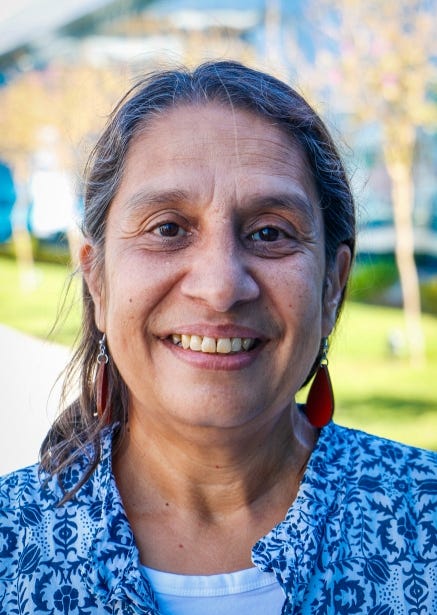
On the first morning of the UN Climate COP29 last November, in Baku, the capital of Azerbaijan, Tasneem Essop sat for her organization's first press conference, draped in a Keffiyeh and wearing a pair of earrings in the form of two slices of watermelon, both symbolizing Palestine. She is the Executive Director of Climate Action Network, the biggest coalition of global environmental NGOs under the UN climate convention, representing more than 1800 organizations hailing from 130 countries. Though not a state party to the convention, it's a real mover at UN climate talks, mounting enormous civil society pressure on parties to raise their ambition and scoring important historical wins, including the quite unexpected early establishment of the Loss and Damage Fund in 2023.
She assumed the role in 2019, after her predecessor was fired for sexual harassment and bullying of co-workers by the board, but not before the toll became too heavy and tragic to ignore—something shocked the international climate circle and prompted soul-searching in CAN International itself. A South African born in the 1960s in Cape Town, who was once a trade unionist fighting apartheid, Ms. Essop brought campaigning energy and organizing prowess to the organization, with justice on top of mind.
She was the first to speak. “Certainly, we're coming to the COP knowing that this COP will be all about the numbers. This is the finance COP. So there are a few important numbers that we need to keep in mind while we're here. Let's start.” But what she did afterwards, was presenting a cascade of numbers that were actually not about finance:
"It has been 404 days since the genocide in Gaza began; there's been 30 days of complete siege in northern Gaza. Over 43 thousand are dead in Gaza, 70% of whom are women and children. Those aged 5 to 9 make up the single largest age category killed in Gaza."The numbers about death and destruction went on.
One week later, her organization would present its inaugural “Solidarity for Justice” award to the Palestinian people, in recognition of “the resilience and resistance by Palestinians for over 75 years of Occupation, the ongoing oppression over decades, and the genocide currently unfolding in Gaza”. This adds to its trademark satirical "Fossil of the Day" awards shaming climate laggards at annual climate talks, which were first presented in Bonn in 1999, when CAN was established there by a group of German NGOs.
She then turned to the numbers that were about money:
"There has been over 19 billion US dollars paid in military support by Western governments collectively to Israel since October last year. Global military spending totaled 2.24 trillion US dollars in 2023, and over 7 billion US dollars are spent annually on subsidizing fossil fuels."
Summing up, she said: “These are the numbers we need to keep on top of mind.”
She went on to put forth civil society's demand for the post-2025 global climate finance goal, which was the top agenda of this COP—"Five trillion per annum", calling it part of the "climate debt" the Global North owes the South.
The number far exceeded what developing countries were proposing before the COP, which was just over 1 trillion, while developed countries adamantly refused to talk about any number. The world would know two dramatic weeks later that the number that finally agreed on was just 300 billion, only to be reached in the distant 2035.
"Governments are absolutely capable of finding the money that does harm in the world. [...] To come here and say we do not have the money is absolutely untruthful in the first place, and secondly unacceptable." By that, she made clear that she was articulating the connection between two causes: climate finance, and justice in a much broader sense.
Through COP29, civil society groups—marshaled by big coalitions including CAN International, Global Campaign to Demand Climate Justice, and COP29 Climate Justice Coalition—campaigned with a concerted focus on climate justice, with a “justice” writ large. They called for an ambitious post-2025 finance package, peace and justice for Palestine, opposition to militarism and fossil fuel-backed war, and safeguarding indigenous people's land rights in face of an impending flood of forest-based carbon credit schemes, among others. Such convergence of issues saw them standing firmly in solidarity with the Global South, while Global North governments were evasive on climate finance and some of the most powerful of them were supporting Israel's war on Gaza.
The issue of justice has always held a place in global climate politics—whether in terms of historical emissions responsibility among nations, intergenerational justice between fossil fuel consumers and those who will bear the consequences, or justice regarding employment during the energy transition. However, the war on Gaza and the resulting humanitarian catastrophe have transformed justice from a derivative issue of climate change into a fundamental question about the very intention and purpose of climate action.
This shift has reshaped the global climate movement. Signs of this change were evident in the protests at COP28 in the UAE in 2023, in Greta Thunberg and her fellow "Fridays for Future" activists' open letter in solidarity with Gaza, in statements from major climate networks such as CAN International and 350.org calling for a ceasefire in Gaza, and in climate groups joining pro-Palestinian protests. This transformation was plain to see at the Baku conference.
To better understand these changes, I interviewed Tasneem Essop in late January. In this open and spirited conversation, she talks about the increasing convergence between climate justice and social/racial justice causes globally in recent years, her understanding of the term "Global South" and why climate movements are embracing it, and whether at COP29 the binary opposition of "North" and "South" really descended into a “chicken and egg” dilemma and impeded progress on the two tracks of finance and mitigation. In a time of ever more troubled geopolitical landscape, she also envisions climate multilateralism going forward.
Of course, she also talks about the transformation journey that CAN International embarked on since she took the helm in 2019, and why achieving climate justice requires building unity and power across movements.
Q: First, I'd like to ask you about your reflection on COP29. I know it's a very multifaceted and very complex issue, but what are the biggest takeaways and the lessons from the experience?
A: The civil society movement including CAN was extremely disappointed with the outcome, especially on finance. This was our big fight for the year. This was a finance COP. We wanted to see a much more ambitious outcome. Especially recognizing that the Global North for a very, very long time, was reluctant to take that responsibility under the UN Convention on Climate Change and the Paris Agreement to provide finance to the Global South.
As civil society, we went into this COP with a clear expectation that we should now finally get an ambitious outcome on climate finance, and a goal that is reflective of the needs and the reality on the ground in terms of what we would require to take climate action in the Global South. You know, the previous goal of 100 billion wasn't based on any calculation of the need. It was generally a kind of thumbs-suck proposition that people in the South desperately needed, so the Global South countries accepted that 100 billion, even though it was absolutely not going to meet the needs. And in turn, the Global North did not actually deliver the 100 billion. There's been all kinds of accounting attempts to say they delivered, but the very definition of climate finance has not been resolved.
So, we, as civil society, largely in a big coalition, through the year, put the pressure on governments to at least deliver 5 trillion dollars of public finance per year from 2025 to 2030, as only part of the climate debt that the Global North owes the Global South.
If you look at the needs and the different studies of what that means, 5 trillion isn't actually ambitious. And others are saying we're going to need more. But we, compared to where governments were at the time, wanted to put forward an ambitious number so that hopefully that would have pushed for more ambition amongst especially our global south governments, whose highest proposed amount on the table at that time, I think was from India, around 1 trillion. And even that included private finance, not just public finance. So we really wanted to center the demand for public finance and put forward that very high number of 5 trillion on the table. The tactic here was to put forward a higher number so that we can pull up the level of ambition going into Baku.
And we did work with governments as well. Before we went to Baku, we particularly engaged with the Africa Group and the LDCs, etc. So that they can also get a bit more ambitious in what their expectations were.
We always knew that going into Baku, this was going to be a fight, right? And we were going to stand very firmly behind Global South countries who were demanding an ambitious outcome on climate finance. But throughout the negotiations, climate finance has always been an obstacle to progress, and of course, climate finance also impacts on all the other areas of negotiation.
The Global North did not put a number on the table until the very last moments of the negotiation. Of course, if people are negotiating and there's no transparency about what the other parties are offering, that just firstly breaks down trust. Secondly, you don't know what you're working with. You can't negotiate if there isn't anything firm on the table. So I think that way of conducting a negotiation wasn't one in good faith, and that disadvantaged developing countries.
It was clear when the first numbers came out, it was 250 billion [only to be reached by 2035]. The Global South reacted with complete outrage. We were outraged too. And so that was the point at which civil society groups stood very firmly and said, "No deal is better than a bad deal", and rather come back at this for the next COP.
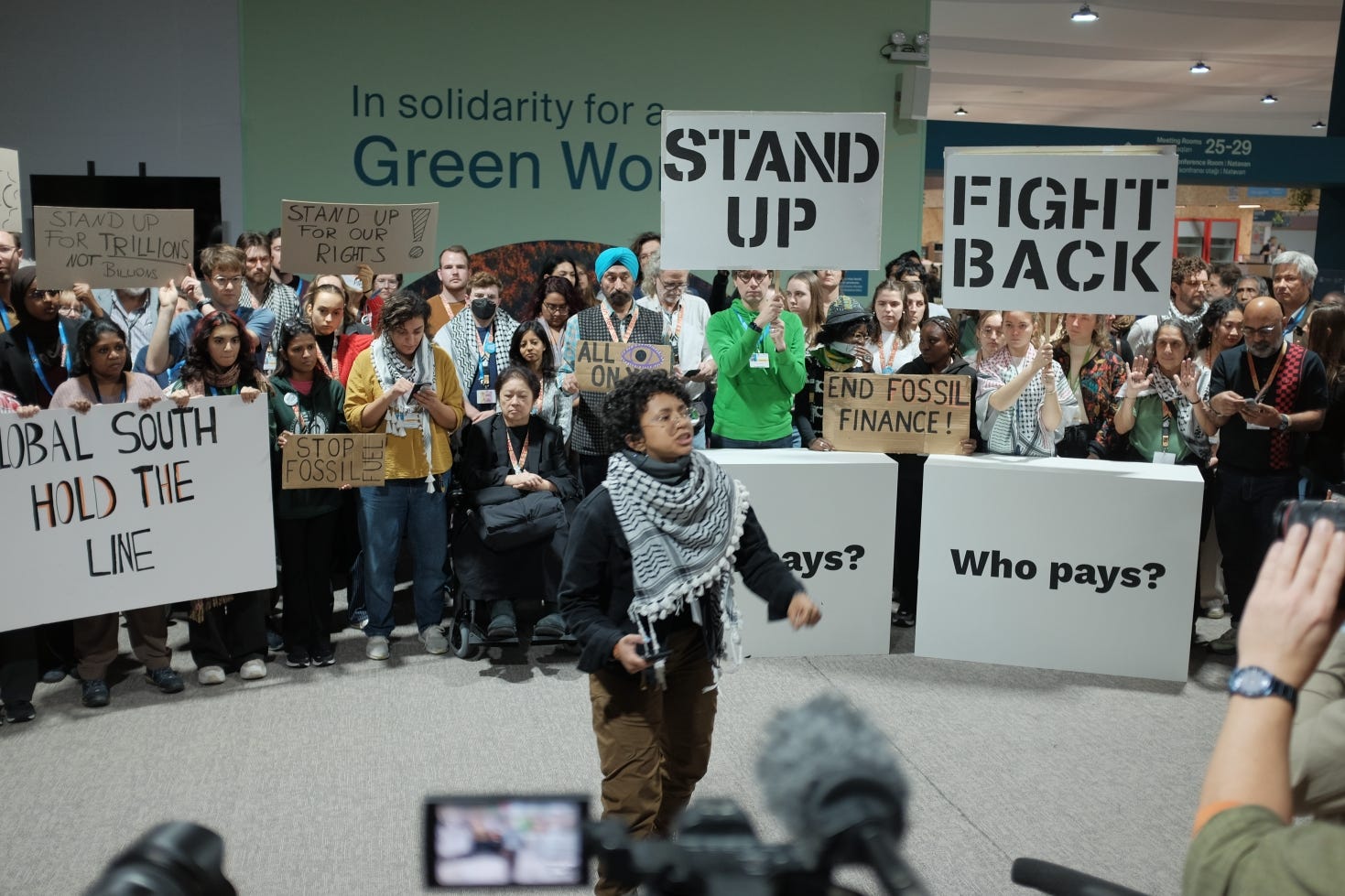
And we engaged with the Global South, the G77+China (a bloc of 134 developing countries in the United Nations) and the different blocks in the G77 just to test that, would they be able to stand behind that. They were super angry about all of this.
But, with the dynamics of negotiations and the pressure generally, we understood that our Global South governments did not want a failure in a multilateral process, they really wanted to maintain the faith in multilateralism, because that is the only real space where the Global South has a voice. Maybe not equal power, but equal voice in the system.
So, yeah, that's where we got to. "No deal is better than a bad deal" wasn't something that materialized and they accepted that weak outcome.
Did the election of Trump play a role in the weak deal finally accepted by the developing countries because they thought that next year in Brazil there would be an even smaller chance for a deal to be struck?
That was the kind of justification from the Global North about why they couldn't put more on the table. All their own domestic politics like the cost of living issues in Europe, the rise of the right wing, and the threat of Trump were used—"listen, take this or else it's going to be worse" kind of thing. This was their messaging and narratives for why they can't do any better in terms of their ambition.
In the end, governments make up their own minds about what they are willing to compromise on. As civil society, we were very disappointed with the outcome. But now that the decision is made, some countries have raised their objections and concerns in the plenary, but are they going to follow through with formal objections? So we don't know where that stands. I doubt whether that will happen. I think people have now just accepted that.
But then there was a very concerning knock-on effect of such a weak outcome on finance, other areas of negotiation were sacrificed as well. So you would know the Just Transition Work Program, which is a very critical area in the negotiations and the negotiators had made progress on, was sacrificed and deferred to the next COP. Of course, the Mitigation Work Program (Note: In UN vocabulary, "mitigation" means emissions reduction and sequestration.) was always held hostage by outcomes on finance.
And then there is the process itself. I've been to too many COPs in my lifetime, including Copenhagen, which was already a really bad experience. But Baku's process was unbelievable.
You would know that the negotiations just mainly went behind closed doors. The presidency convened bi-laterals or meetings with blocs, etc. And they all happened behind closed doors, in fact, in the presidency suite. And civil society did not have sight of what's going on. It wasn't transparent.
How did we get to the decision? What was traded off? Who were the ones that were blocking? You have to get information about what's happening behind closed doors, so that we get a sense of things and we are able to respond. But then the presidency just gaveled through the decision. It was very shocking.
So I think that it was not just the outcome of the negotiations, but the process at this COP that was also seriously worrying. And we certainly don't want to see that as setting a precedent for any future COPs.
So, do you think the UN climate regime is in need of reform, as what was called for during the COP?
There are areas that would require reforms, not just because of Baku, but for all our experience over the years.
One of them is the role of civil society in these spaces and what meaningful and inclusive participation of civil society looks like. I'll give you a practical example.
Obviously, we're not involved in negotiations, and I don't think the UN system and governments are ready for that level of inclusivity, but when we are called upon to speak at the plenaries, we literally get only two minutes per Observer constituency.
This is the same for the environmental NGO (ENGO) constituency. We are one of two focal points for ENGOs, and we have a sister focal point which is DCJ [Global Campaign to Demand Climate Justice]. Because of that, the two minutes have to be shared. So, here you have two very big global networks literally having one minute each to articulate their views in a UNFCCC process.
And then, other participation, say when contact groups meet etc, it is up to the chair to decide whether we can speak or not. And to a large extent, if one party objects, we can't speak. So, our participation there is not really meaningful. And that is why we've chosen to have a voice outside of the rooms.
That's why you would see us putting that pressure on negotiations using the only other method that we can use and that is our action. Peaceful demonstrations outside the meeting rooms raising our voice and pushing negotiators to raise ambition.
The process in the UNFCCC has to be transformed in a way that gives us much more meaningful opportunities to participate. So, yes, I would say for civil society that's one of the areas that we need to transform the UNFCCC.
I think a second area of transformation would need to be this: you can't leave the decision on how negotiations need to be conducted to individual COP Presidencies themselves. There has to be some kind of basic guidelines that all COP Presidencies must follow.
But currently we've seen that from one COP President to another COP President the approaches to the process are different. It's too risky to do that.
Because of the particular way the UN climate regime makes decisions, which is called "consensus decision-making" in which there is no operational definition of what a consensus is, the presidency enjoys ample freedom to use the gavel. And some scholars are now arguing that there needs to be some degree of voting in making decisions at COPs, to constrain the presidency. What do you think of this kind of suggestion?
There's one step before that. This is a party-driven process, so the presidency should not be driving the process in the way Baku did. We can't have a presidency deciding what a party-driven process should look like.
The second one is this issue of consensus. It only takes one party to just object, and there's no consensus. So you're right, the rules of consensus have to be clearer.
And on the point of voting, I don't know if it's still on the agenda, but there used to be a standing agenda item put forward by Mexico on voting.
Especially when things are getting tougher and tougher in the multilateral space, maybe clearing up some of these operational rules would be really helpful, in a space deeply affected by geopolitics, where the levels of trust have diminished over the years. In such a context, I think the rules need to be clarified, and also the role of presidencies and what they can and cannot do.
There's a host agreement signed between the UNFCCC and the presidencies, those host agreements should be looked at and reviewed and see whether it should be tightened up.
So I think there's always room for strengthening and improving with the aim to become far more inclusive, far more transparent across the board and also, of course, to become effective. We don't have time for this kind of slow pace with which this process is delivering results.
CAN will soon go to our strategy meetings. One of the big issues is going to be how we build multilateralism for impact. Of course multilateralism is under threat right now. We know that the multilateral space across the board is not necessarily being effective in delivering and addressing the big global crises of the times, but it's the only space the Global South has, really. If we go into our little bilateral or regional relationships while dealing with global crises, that's not going to have an impact either. And in fact, we'll probably just reaffirm existing power relationships in the world.
Could you envision the road ahead for global climate movement and climate diplomacy, considering what's currently going on in the US and in Western democracies, with the rise of the far-right politics and oligarchy, etc.?
Look, the kind of power of oligarchies have always been there. What is happening now is, of course, they're consolidating power and it's becoming much more visible to us. It's expanding that power and it is being bolstered by this emerging rise of right-wing politics across the board in the US, in Europe, but in other places in the world, even in the Global South.
So in such a context, for us, if the US and if other Global North countries take similar paths, I believe that we really have to look at the South-South collaboration much more strongly.
We probably need to reflect on the fact that for many years, and of course this comes out of the legacies of colonialism etc., the Global North has built this economic dependency on itself of the Global South. Meanwhile, we've also experienced, especially in the climate crisis space, that the Global North has put no real commitment to helping the Global South.
In such a context, I think the message is pretty clear. The Global North will never have the interest of the Global South at the front of their minds. They just haven't proven that there's a real track record around that.
Let me use another example.
During COVID, what did the Global North do? They went inward, they took care of themselves. They were not even willing to provide Global South countries with much needed vaccines. They weren't even willing to share the intellectual property of their vaccines.
They've built close relationships with certain blocs for their self-interest. In the climate space, they've often tried to play divide and rule tactics with the G77+China bloc—for all the differences and challenges within the bloc—so that they have their interests protected.
The one thing that we know is that if the G77+China stands strong and united, you actually make progress. And the Loss and Damage fund is just one example of that. But it's sad that the G77+China has not had many examples where they have stood united. There have always been breakaways.
So to what extent has divide and rule tactics actually worked in breaking down the unity of the G77 when they need to be united on some of the key issues? For me, looking forward, understanding that will have a huge impact when the US withdraws [from the Paris Agreement] like they're doing now.
I think this is where now as the Global South—not only governments, but also civil society—we need to look at to start strengthening our solidarity, our collaboration, our independence in relation to the Global North. How do we start lessening our dependence? How do we start unraveling the apron strings to the North? If we were not so in debt, if we had sovereignty of decision-making, if there wasn't all this interference when our resources are being extracted and going to the Global North, if we add sovereignty over all of the critical minerals and other resources, we could very much stand on our own two feet.
So, I think that it is time for us to look at the South-South collaboration much more strongly.
So how do you see China's potential and current role in this? It's quite a divided picture, right?
There are, of course, huge advantages and strengths in terms of China's role. And then, of course, there are these challenges, the kind of extractivist role that they play. But China has been part of the Global South, and it is the only real powerful player in the Global South right now, if you look across the board, just in terms of its economy, in terms of its innovation, its progress and advancements in terms of technologies.
And so I think China can play a role in helping that shift of dependency on the Global North more and more towards South-South independence and collaboration. We need China to also reflect on its relationship with the others, that this isn't just about China's needs.
We need an alternative model because all of us have been caught up in the existing hegemonic model of economic development, of politics, and even culture. Many of the Global South countries aspire to be like Western countries, whereas I think we should be looking at alternative models and we should become the leaders where, in fact, the Global North looks to the South for leadership, for alternatives, etc. That's my kind of a dream, if I can say that. It's time.
I'd like to highlight the divergence within the Global South. COP29 may be remembered for the sharp dichotomy and "chicken and egg" dilemma where developing countries demand funding from developed countries, while developed countries require developing countries to first demonstrate their commitment to emission reductions. But at the final stage of the negotiations, after their walkout protest, Cedric Schuster, the chair for AOSIS, made it clear in a statement that as the most vulnerable developing countries, they actually wanted progress on both climate finance and mitigation, and were frustrated for being ignored. And we would know shortly afterwards that Saudi Arabia, a developing country, was consistently blocking any language on fossil fuel going into the Mitigation Work Program document. Had Saudi Arabia not done this, maybe developing countries would have made some compromise on mitigation, and this compromise could have served as a leverage for more funding. Do you think the kind of bipolar opposition between developed and developing countries disguised the conflicts within the latter and impeded progress on both agendas at COP29?
Now look, the divergences inside the G77 isn't unknown to us. We know which agendas are getting driven by which blocs and which countries actually, like Saudi Arabia, plays a consistently bad role when it comes to any levels of ambition around 1.5, mitigation, etc.
For a long time, the conversations and the negotiations around mitigation actions have been caught up in this chicken and egg situation, with one side saying we can do more if the funds came, the other saying funds will come if you do more on mitigation. So which one comes first?
The conditional NDCs have conditions attached to them, conditional on finance. You tell me whether the finance was delivered for that. So the governments of developing countries are saying, we can do this, if we had this funding, but they didn't get the funding.
So, you know, often we also have to look at track records and good faith. We've had the Paris Agreement for 10 years now, right? Not translated into action.
You didn't need a negotiation text for you to know that to stay below 1.5, you needed to stop your production of fossil fuels, especially in the North. And what did they do? They continued expanding production, expanding investment in fossil fuels. And at the same time, not really delivering the finance.
And so yes, of course, mitigation is important. But besides players like Saudi Arabia who might not have real commitments to it, there is also China. What has China done? They like to point fingers at China, saying they are not doing enough, but, in terms of renewable energy, it is the most advanced in the world.
So it's not like there isn't a commitment in Global South countries to do more.
Take my country, South Africa, we've articulated the need to shift away from our dependence on coal in the NDC. We have this JETP (Just Energy Transition Partnership), which is mainly loans-based, by the way, loans-based, which puts a massive burden on the population in South Africa.
So in such a context, you can't trade off the one with the other. You need to have delivery of finance which then allows for more mitigation actions.
And I think some parties will think, no, no, no, if we had just said something about transition away from fossil fuels, whatever, in this COP, it would have unlocked a lot more finance. I'm very skeptical about it. I just think where we landed on finance is where the North wanted it to be. It had nothing to do with Saudi Arabia blocking and the Global North wanting to see more action.
We must not look at one-off events. We have to look at track records. There's no track record on this.
And then the other thing I want to raise is this idea that if you didn't discuss the transition away from fossil fuels, it means that you're not going to take action on it. Nobody, no parties have said we're coming to rescind the decision that we've made at COP28. (Note: At COP28, parties for the first time in the history of UN climate talks agreed to "transition away from fossil fuel".) So what excuse is there to not deliver on it? Do you need another discussion, or do you implement the decision? Everyone needs to go back home and deliver the transition away from fossil fuels. The decision has been made. What further decisions do we need to make about it?
COP28 decided all countries must transition away from fossil fuels. Here's your decision. Now you tell us how you're going to do it. You tell us what you need to do. You tell us why you're not doing it. That's the conversations that need to be had, but the decision was made already.
So I don't know. People were saying this to me, "but what about the fossil fuel discussions, there's no space to have that discussion", but our existing architecture allows for accountability. There are the biannual communications or the transparency frame, etc.
The NDCs are also coming up. If COP28 said all countries must transition away from fossil fuels, surely your NDC would need to reflect it.
So, if the decision has been made last year, why not just do it again this year in exchange for leverage on finance? That doesn't seem to be much of a sacrifice.
Just tell me, isn't that a little bit of smoke and mirrors just to repeat the language of COP28 and that is leverage? I'm not sure if it's a red herring, to obfuscate the fact that they owe the Global South funding.
And that the Global South doesn't want to take more action is a total lie, by the way. Developing countries are taking action. They're taking action and they're doing it with their own funding also. In fact, in not only mitigation action, whenever there's a big huge disaster in all our countries, who's funding that? We're funding ourselves.
So I believe that was an obfuscation. I couldn't understand that, even in our own organization, people were like, "but there's no space to discuss fossil, the transition away from fossil fuels." But there is space to discuss it. Discuss it in NDC. We're pivoting to implementation. Let us push very strongly that your plan to transition away from fossil fuel is included in there. And then for developing countries who need finance to help with that transition, put your finance needs in your NDC.
So I don't think that was a real basis. It was not, I think that was an excuse and a justification to defend what was indefensible. And that was the low ball on finance in the way they did.
And then not only did they come with a low amount, but they also then go and shift responsibilities to the private sector, to MDBs (Multilateral Development Bank), and essentially start dismantling the convention and the Paris Agreement that requires developed countries to provide finance to developing countries.
So there are bigger things at play, not about who's not willing to talk about fossil fuel phase-out.
That's my sense. I'm very skeptical about it because, you know, as I said, I've been in these negotiations for a very long time, and there's always some kind of justification for why developed countries are not delivering on their obligations.
Thank you for clarifying. I was just thinking that developing countries could have removed that "straw man" by just agreeing on stronger language on mitigation.
They would have shifted the goal posts. I promise you that.
I'd like to turn to the transformation of CAN international itself. In 2018, CAN International was at the center of a big storm related to the conduct of its then leadership. Consequently, there was soul-searching and reforms within the organization, and you became the new Executive Director. Besides, CAN International started in the West, but it now unambiguously assumes Global South perspectives. Are these two things related, and what has changed within CAN? At COP29, I had expected the CAN lineup to look quite white, but was quite surprised to see that it was not.
That's right. Thank you for observing!
It's over 35 years since CAN was established at the start of the Convention (UNFCCC). At the beginning, CAN was pretty Western, we would call it Northern-dominated. It was set up by Northerners. It was pretty much focused on the inside of negotiations, policy work, etc.
I was engaged in CAN when I was working for WWF, as a member of CAN. And during that time we were already starting to push CAN to become more representative of the Global South. I'm personally very committed to transforming CAN, especially when it comes to representation of the Global South.
And of course, and then, after all the things that happened, I became the head of CAN in 2019. I was away from the international space for three years and the board reached out to me to ask if I could be an interim Executive Director, just to stabilize CAN. I wasn't really doing anything at the time and I came back in and did that.
And it was fantastic actually. Because when I came in 2019, of course I was like, "My goodness, here's the opportunity that we couldn't achieve many years ago. Maybe we can do it now."
It was coincidental that I came just when CAN was planning its annual strategy meeting at the time. What was happening at that time were two things. One, Fridays for Future just broke out. So the youth mobilizations had just broken out. And two, the IPCC's 1.5 special report came out.
And when you're going into a meeting to address a strategy for climate action, you can't ignore these things. The special report was sounding a massive warning to us. We have an emergency on our hands, and young people are going to the streets, telling us there's an emergency!
And so I challenged our members at the strategy meeting about being business as usual—we can't be, we can't carry on just doing what we've been doing for years. We're going to have to shift our approach. Our strategy had to respond to this emergency that we are having now!
Secondly, I also challenged the network because it was a pretty top-down network—the secretariat, a lot of technical experts that really had the power, etc. We proposed to flip the organization to become a bottom-up organization driven by our nodes—because implementation happens at national levels—and we needed to center our nodes more.
So we decided to shift the network into a more bottom-up network, one in which our Global South nodes would be built up and capacitated and get better representation and voice. And there was a plan to do that.
And then in addition to that, we set up a node development fund, which is basically an internal re-granting mechanism in our secretariat. We would of course take care of the secretariat's funding, but all the additional funding that we got and fundraise around would go into a node development fund to support our Global South nodes, to deal with the resource inequity that exists in our network—between the resourcing of Global North and Global South nodes. Most of the Global South nodes had one person who was volunteering. So it was really important to shift resources to the South.
We've been doing that and this is now our sixth year of implementing the node development fund. And even with a little bit of money, we could see the progress—just by remunerating a node coordinator, made such a difference!
So, internally, we took decisions in 2019 already, to start a transformation journey, and we have been doing that over the years.
Another big part of that journey was to build our bridges with the wider climate movement. Not many people liked us in the climate movement, you know. Of course there was the kind of breakdown between CAN and DCJ (Global Campaign to Demand Climate Justice), and because of that, the wider climate justice movement people, not just DCJ, but all those in the climate justice networks and movements did not have a good relationship with CAN.
Why was that?
Because we were seen to be Northern and conservative.
I see. While they had been more representatives of the Global South, right?
Yes, exactly. And so because of some of our policy positions that were taken, which were pro-market, carbon markets, etc. So there were differences, policy differences, but also, how we stood and how we were coming into the space. We're still on our journey in terms of climate justice, while these others have been the justice movement for ever. We are just coming to the climate justice space now recently, in the past few years. We use the language, but it has to be part of our DNA, if you can call it that, which we have not achieved yet. And the transformation towards a really strong Global South voice, there's still work to do in our network.
I'm just happy that we have built unity, that we've agreed that we won't let our differences divide us on the things we agreed on. And we tried to build consensus on key issues, like that on climate finance, the five trillion demand, and it took a lot of discussions between allies to reach an agreement on that.
I made it our responsibility to build the bridges, to build the unity, to go and fix up all those difficulties. And that's why you would see, we are united now, we're working together. So yes, there has been a very strong and deliberative transformation process in CAN in the past years.
Was COP29 the first time for you to campaign together?
No, we've been campaigning together since COP25 in Madrid (in 2019).
In addition to campaigning at COPs, what do you do together outside COPs?
In the past, we would do our advocacy work as CAN alone. But because you need coalitions and power to win, we decided to introduce something called the "escalation strategy" at the time of the Glasgow COP26 and we tested that with the Loss and Damage fight. What that essentially means is that you choose one big fight that you want to win and have to win. And even if we are working on other areas of work, you build massive support for that fight, and fight it.
So we went to Glasgow, even though the Loss and Damage Fund wasn't on the agenda of the Glasgow COP, we said we're going to make this issue an issue that cannot be ignored.
Before the COP, we were doing our pressure work. And then at the COP, that's when the consistent collaboration with DCJ and other allies started becoming sustained because we fought together on Loss and Damage, and we won it in Egypt (at COP27). It really was a civil society victory. Then we cooperated on the phase out of fossil fuels. We collectively worked on a campaign called "The Global Fight to End Fossil Fuels", and then we had the outcome on "transition away from fossil fuels" in Dubai. And we did the same thing on finance, which we didn't get a result on, but at least, we worked together really well.
So, there are fights that we fight together. It doesn't only happen at the COPs, we have a whole [process]. Before the COPs, we had a [steady] drumbeat of actions and advocacy work that we did together, around these big fights that we chose.
In recent years, we have seen an increasing convergence between climate and social, racial justice causes in climate movements. At COP29, civil society groups including CAN International and Global Campaign to Demand Climate Justice also made the issue of the war on Gaza highly visible. How has this convergence come to be over time? How has CAN International's support for Palestine been received?
Well, look, I can tell you that, when the issue of Gaza all started, it was not just in CAN, but across many of the climate networks and movements, especially networks that are global, with membership from both the Global North and South and the divergence of opinions about this, it was a very difficult issue to manage. And we recognized it wasn't going to be easy in CAN as well. But we can't ignore it, right?
You know, we're not fighting the climate crisis because we just want to see more renewable energy. We're fighting climate change because of the impacts it's going to have on humanity and the planet, right? It's not because it's a technical thing. It is because we have deep compassion for people and their lives and for justice.
And so certainly when we talk about climate justice, you can't actually ignore its relationship to other forms of injustice, when something as big as Gaza happened. And so we had the discussions in the network. It was very difficult.
I must tell you, as someone who has always assumed that as civil society, we would stand on principle for human rights, for justice across the board, it's a matter of principle.
It was actually a very difficult thing to manage. But in the end, we dealt with the kind of minority of voices who were not supportive, the majority felt we should actually put out a statement calling for a ceasefire, which we did.
And then as the year progressed and it became clearer and clearer, with the ICJ ruling, and towards the end of the year, and with even our own members Amnesty International and Human Rights Watch, as well as other genocide experts started saying: "But what we're dealing with is a genocide."
I think what then happened when the horror on a daily basis got unveiled to people, that kind of uncertainty about where the people stood at the beginning also shifted, because the horror was just too clear.
So, unlike in Dubai where we were not visible under CAN’s name, but as individuals, in the protests and other actions, by the time we got to Baku, that changed. People were like, we cannot be silent on this. So we joined with all the others in those actions, standing in solidarity with Palestine.
Has that resulted in problems? Yes, of course it has. You know, Western governments will have a problem. They have a problem when their own people are standing in solidarity with Palestine. We saw the police beating up their citizens, etc.
So it was not easy, but there's a point in all our lives where you don't want to look back and say that you lived through a genocide happening on our watch and you were silent. You have to make that decision. So there's going to be, I suppose, a sacrifice that you make in that decision.
And, you know, I am not sure to what full extent it has had an impact on CAN and whether taking this stand will impact on relationships with Northern governments, but I hope that, the “champions” of democracy and human rights in the North, in Western countries, recognize that this is fundamentally about human rights and fundamentally about the right to freedom of expression. So, to react in a way that tries to either victimize you or persecute you or deny your access to them would be pretty bad for a “democratic” government.
We've not experienced anything like "We don't want to have a relationship with CAN", but they won't do it in a very open way. I don't know, let's see how the full thing plays out.
But to CAN and many, many people in CAN, this is a matter of principle.
And by standing unequivocally in solidarity with Palestine, you are also trying to create a cultural change in the global climate movement, and it's far from a done deal.
Yeah. For a very long time, many in the climate movement were in their own, if I can call it, bubble—we just focused on the climate, we focused on GHG emissions, we're into the negotiations, and this is our job.
It didn't bring about the change we needed. As CAN, we’ve just had a whole long discussion about the negotiations and how geopolitics and power play into them. If we don't have that analysis, if we don't see climate change as connected to everything else in the world, we won't be able to bring about change. So I think more and more what's happened with the climate movement is that they've realized that climate is fundamentally connected to everything else, to politics, to societies, to social justice, to the finance architecture, to the economy, and of course human rights is fundamentally linked to all of these. That's why there's an ICJ advisory opinion being sought right now on climate change and human rights, right? (Note: A resolution supported by 132 countries at the 2023 UN General Assembly requests the International Court of Justice to provide an advisory opinion on the obligations of states in respect of climate change. Human rights as enshrined in international law were one of the foundations for raising this question. On 23 July, 2025, the court issued the opinion, affirming that states have obligations under international human rights law to fight climate change.)
So I think that realization has come in the past few years in CAN, as well as the breaking down of silos between movements. So more and more, movements fighting for social justice are connecting to climate justice, movements fighting on debt justice, for example, were very engaged in the climate finance fight last year. So it's really healthy, because to bring about change you need collective power and unity, not silos. We have to build power across movements.
Did the Black Lives Matter movement that took place in the United States and elsewhere back in 2020 also contribute to this kind of convergence?
Black Lives Matter definitely had an impact on the climate and environmental movement. In that whole period, there was a big call out, especially against what was called the "big greens", for not being diverse enough. The whole diversity, equity, inclusivity issue became a big thing. The solidarity with Black Lives Matter was not only in the US, but became a global phenomenon.
But I will say it's interesting that, the openness to standing in solidarity with Black Lives Matter on these issues of decoloniality—in our network, we introduced decoloniality before Black Lives Matter actually—was much greater than the openness to the Palestinian solidarity.
I'm talking about Climate Action Network and it might have applied to others as well. In our network, there are human rights groups like Amnesty International and Human Rights as our members. But as a global network, we weren't taking much of a big human rights specific stand until we got to Egypt. And that was because of the Egyptian activists calling on the climate movement to use the COP to amplify the voices of Egyptian political prisoners.
Again, that was easier to do than taking a stand on Palestine. We also stood with Ukraine, and that was also not a difficult decision in our network by the way. How is it that when we needed to stand in solidarity with Palestine it took very long and difficult discussions in the network.? So yeah, it's been challenging and interesting.
You actually find the masks have come off, the veils have come off. You see what you're dealing with right now.
We have been talking a lot about "the Global South". The term has gained renewed prominence in recent years. But some scholars and commentators have disputed its validity. For example, the American political scientist Joseph Nye wrote in late 2023 that it's "a misleading and increasingly loaded term" still in use only because of lack of an alternative shorthand, and others have argued for its retirement because they think it ignores the diversity of the world, and even called it "pernicious". How do you define and see this term?
CAN doesn't have a definition of Global South, so this is my personal opinion. So for me, the Global South is a political concept rather than a geographic one. And it is a concept that probably captures broadly where the Non-alignment Movement transitions from—the past of that colonial legacy, and the Non-aligned Movement then being the voice of the former colonies, and that are now called the developing countries.
And so, that sense of the political unity of those countries who have come through similar histories of colonialism, domination, independence struggles, of under-development and deliberately under-developed.
So, for me, the Global South has pretty much that political dimension embedded into it.
Has things changed?
We still have colonialism in some form or the other, right? People don't think about neo-colonialism, but power relationships haven't shifted.
There are new forms of colonial power. We just had the long conversation about it—how that power is being used today, the old colonial power is being used differently. It's taken different forms, but that power relationship hasn't really changed.
And I think the war on Gaza has really made many people more aware than ever of this power imbalance.
Absolutely. But again, think about Covid. So, that's why I will always be skeptical, and there are reasons for why some people are wanting to challenge the validity of the concept of the Global South. It's pretty much the same thing. It's like, "we can't have a strong Global South", "they shouldn't be united", like the Non-aligned Movement, the precursor to the G77 plus China. It's always the intent. That's what the colonizers did.
That's what we experienced in South Africa when we were living under apartheid. They divided and ruled. That was the masterstroke of apartheid. They kept the black people divided in the country and gave us different racial categorizations. Divide and rule is the most potent weapon that those who want to keep us dependent, will use.
In the end, the reality is clear. The power relationships haven't changed. The military power that gets used hasn't changed. The trade relationships haven’t changed.
So, climate justice is very much about the balancing of power between North and the South. Otherwise, climate justice cannot be achieved.
It's not only the balancing of power. Fundamentally, you can only achieve climate justice if we also change the system that causes the injustice. So, it's not just about climate.
Again, for us to address this crisis and other crises, whether it's inequality or the poverty crisis, that would need system change. Without that, we will be plastering over the existing problems. So, to achieve sustained climate justice, you would need to change the system.
As a grass-roots and people-centered movement standing in solidarity with the Global South, how does CAN interact with Global South states, considering some of the governments are not particularly supportive of human rights, equality and justice domestically?
The CAN network is composed of what we call nodes across the world in over 130 countries. For example, we have a South Africa CAN who works domestically. And then we have a regional node where South Africa CAN is also part of, Southern Africa CAN. And we have CAN Europe, for example, but we also have a CAN France. So we have a mix of national and regional geographical nodes. Then we have international members, like big international NGOs like Oxfam, ActionAid, Greenpeace, WWF, Amnesty International, etc. So we are a very big diverse network.
When there are domestic situations where there's human rights violations, transitioning away from fossil fuels, all the domestic work, our nodes do that work. We don't interfere, we can only guide. In that way, they connect their domestic work to our international work. Our international work is informed by the work they do and prioritize, but we don't interfere. So if they reach out to the global network for solidarity, we stand in solidarity.
I'll give you an example. In Uganda, they were arresting many of the activists, especially the ones that's protesting the EACOP (East Africa Crude Oil Pipeline). We were called on to support and then we stood in solidarity and we raised voice.
When we go to COPs, we also raise voices only when domestic activists ask us: Please, we need you to use your voice to highlight something. In Egypt, it was about the political prisoners and we stood behind the call to release Alaa Abd el-Fattah.
Of course, domestic inequities are something we take up. It's not just Global South versus Global North. It's what happens inside countries and that inequity inside countries is a very big issue. It's almost a microcosm of the global inequities.